
© Text by Dr Helena Chacón
The Sierra de Huelva, is one of those places that captivate everyone who visits it. Its beautiful forests, magnificent cuisine, rich culture and the friendliness of its people make it an international tourist destination. Little is known, however, that in addition to all these attractions, the region is a globally unique site due to its geology. Experts from all over the world visit it to gain a better understanding of events that have affected our planet, the traces of which can be seen in the rocks around us. In this text, we aim to raise awareness and encourage interest in learning more about the «abiotic» aspects of our region.
LOCATION
The region of the Sierra de Aracena and Picos de Aroche forms part of the south-western strip of Sierra Morena. It forms part of what is known as the Iberian (or Hesperic) Massif, which covers the entire western part of the peninsula and whose formation is the result of a whole series of geological events spanning from 650 million years ago to the present day. Although the Iberian Massif may appear today to be a single block, it is in fact a series of distinct ancient tectonic units that were joined together by orogenic processes. These units include the Cantabrian Zone, the West Asturian–Leonese Zone, the Galicia Tràs-os-Montes Zone, the Central Iberian Zone, the Ossa–Morena Zone (ZOM) and the Southern Portuguese Zone (ZSP). The latter two are found in the province of Huelva:
– The Ossa-Morena Zone (ZOM) occupying mainly the mountainous region and corresponding to the former microplate of ARMORICA
– The Southern Portuguese Zone (ZSP) belonging to the Andévalo and Cuenca Minera areas, which form part of the plate AVALONIA
Among these is a SUTURE ZONE, a complex tectonic feature of great geological interest
OROGENIES
In the Sierra region, we find a wide variety of rock types. By reading the traces of the past in them, we can piece together the history of the region and the major events that unfolded over millions of years.
To understand the various geological periods detailed below, you need to realise that the continental boundaries you see on maps today are around 200 million years old. The rocks found in the Sierra are mainly between 600 and 500 million years old, down to 350 million years old, which means they were formed on a planet where the continents were different. Thanks to plate tectonics, we now know that the crust is constantly being created and destroyed, and that continental plates can move in terms of latitude and altitude, etc. And amidst all this movement taking place between the lithosphere (the crust and upper mantle) and the asthenosphere (the mantle), major collisions between plates occur, creating vast mountain ranges. This process is called OROGENESIS.
In the Sierra de Aracena, we find significant evidence and records of mineralogy, deformation and metamorphism relating to the Variscan or Hercynian Orogeny (300 ma). However, we can also find evidence of the effect of the earlier orogeny, the Cadomian and the next one, the Alpina.
1. Our oldest foundation
Precambrian 650–540 Ma
Our story begins in the Late Proterozoic and its transition to the Cambrian (beginning of the Palaeozoic) the time when the oldest and most fundamental rocks of the mountain range were formed, some of which date back more than 540 million years.
To understand the whole story you are about to immerse yourself in, you must imagine that the mountain range you are in was once a place submerged beneath the sea, with a few small islets. On the ocean floor, millennia upon millennia, layers of silt, sand, limestone and volcanic sediment were deposited; over millions of years, these were compacted and cemented, metamorphosed and eroded, first by the Cadomian orogeny and secondly by the Variscan orogeny. This sequence of sediments is known as the Umbría Formation or the Black Series (aged Riphean-Vendian) consisting of schists, grauwackes, black quartzites and slates interbedded with amphibolites and metavolcanics… which can be seen in Linares de la Sierra or Aracena.
We are talking about a time when the planet had gone through what is known as the Cryogenic Period or Snowball Earth (850 to 635 ma), after which life re-emerged vigorously during the Ediacaran period until around 540 ma. The oceans were inhabited by soft-bodied animals, lacking shells or skeletons, eyes and antennae, such as Charnia, Dickinsonia and Kimberella. The continents were beginning to change as a result of the Cadomian Orogeny. Sediments of the Black Series gradually accumulated in the marginal retroarc basin the result of a young volcanic arc associated with subduction.
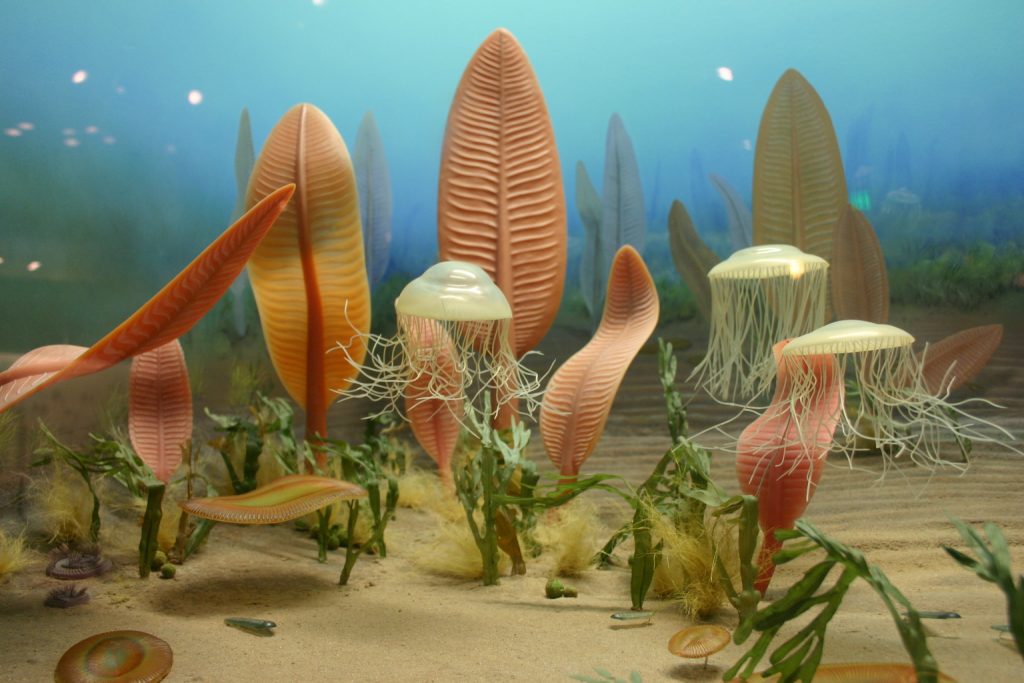
Ediacaran fauna www.wikipedia.org
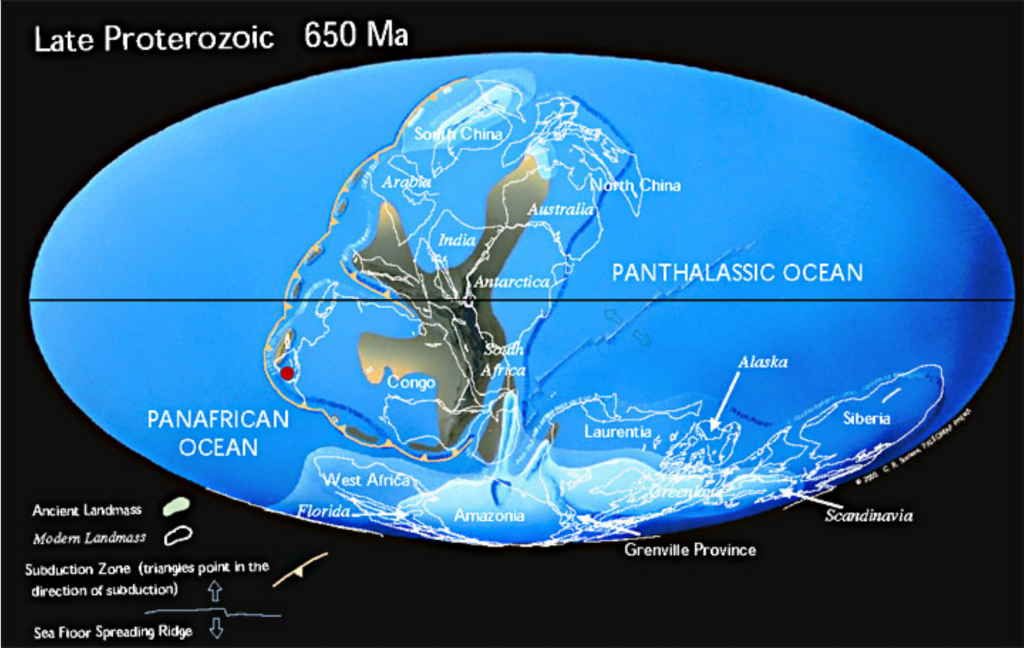
Late Proterozoicwww.scotese.com
2. The Rheic Proto-Ocean
Cambrian 540 Ma
Following the Black Series, a massive mass of rocks of origin volcanic-sedimentary interspersed with carbonate rocks which gave rise to much of the mountain range’s rock record and some mineralisation in the north of the province (Cu, Zn, Au), marking the transition from the Precambrian to the Cambrian and, with it, the onset of the Palaeozoic. Palaeogeographically, we were part of the Gondwana continental shelf. To the north-west lay other, somewhat smaller continents known as Laurentia, Baltica and Siberia.
These rocks tell us of a shallow, calm and warm sea (continental shelf) within a retro-arc basin that began to undergo a process of «rifting» or oceanic spreading (an extensional event), marking the beginning of what would later become the Rheic Ocean. This event produced a thick layer of Bimodal volcanic-sedimentary rocks (acidic and basic) which form the core of the central part of the Sierra de Aracena and Picos de Aroche region. Interspersed amongst them are lenses of metamorphosed limestone and dolomite (marbles) ; they have traditionally been used as building and decorative materials and in lime kilns, and they also form the backdrop to some of the region’s most distinctive sites, such as the popular Gruta de las Maravillas or the Peña de Arias Montano.
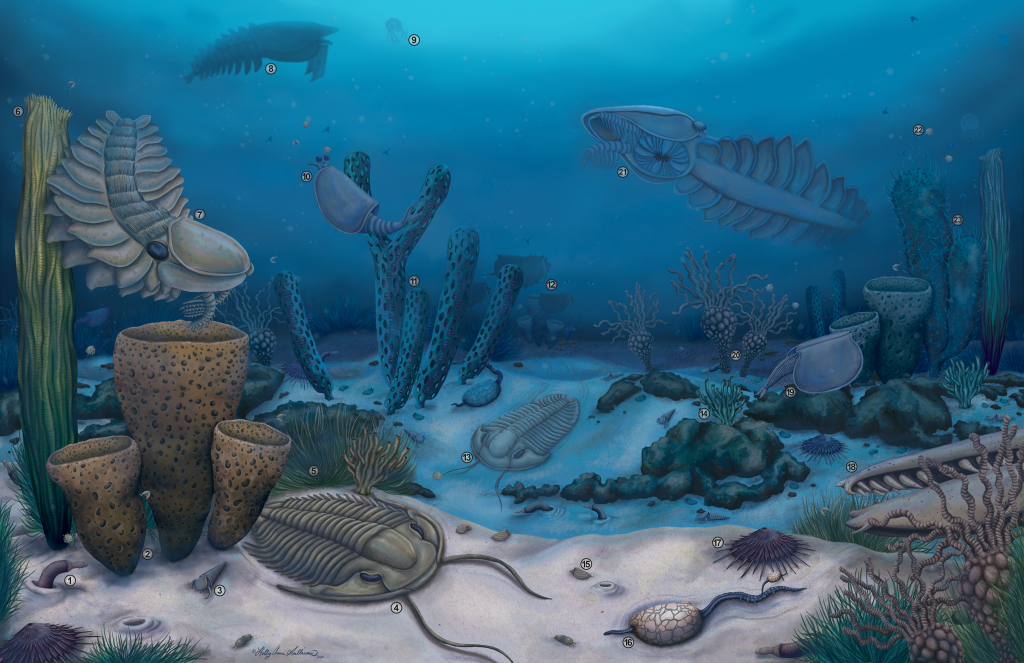
Cambrian fauna wikimedia.org
This shallow marine environment, with clean, clear and warm waters, as suggested by the reef structures of Fossil stromatolites (at Cañaveral de León) gradually became deeper and the oceanic crust grew through cracks and fractures through which basic volcanic rocks emerged; we found outcrops of these in the form of Pillow Lavas or padded lavas (Cumbres Mayores or Cañaveral de León). The tectonic movements of that period produced sedimentary sequences ranging from fine-grained to coarser-grained (slates, conglomerates, grauwackes), indicating the erosion of exposed areas such as the Slate from Herrerías.
In these seas there were neither fish nor marine mammals, but rather sponges, jellyfish, molluscs and arthropods (the first animals with exoskeletons). Among the most popular of their kind are the Trilobites, animals that are now extinct. This period tells the story of an unprecedented explosion of life on the planet. In the Sierra, we have few fossil records from this period (not as many as one might expect) because the rocks have undergone several phases of deformation and metamorphism, which have erased some of the biological remains that must have been left behind from this fascinating era. However, we do find trilobites at certain sites, such as Cañaveral de León and Arroyomolinos de León, belonging to the genera Triangulapsis, Eodiscus, Scenella and Delgadella, as well as brachiopods and traces of biological activity by organisms (ichnofossils).
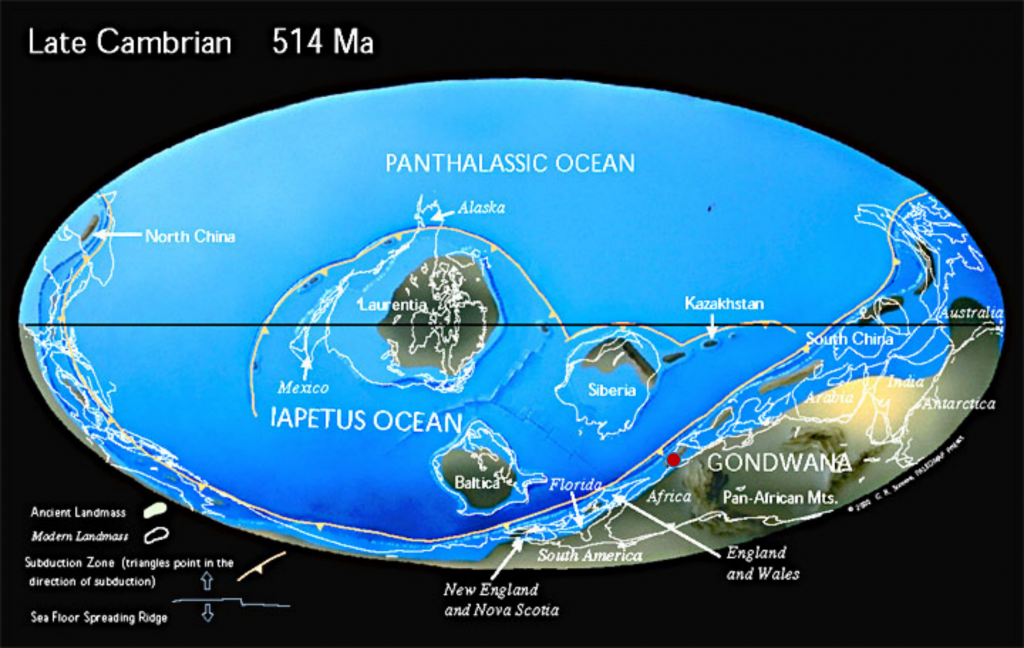
Late Cambrianwww.scotese.com
3. The Formation of the Rheic Ocean
Ordovician – Devonian 460 – 360 Ma
Throughout the Middle Palaeozoic, there were significant tectonic changes in our region. The two plates that make up the two tectonic units of the Huelva section of the Iberian Massif took completely different paths. Avalonia, the area that currently corresponds to Andévalo and Cuenca Minera is shifting towards the NW during the Middle Ordovician (480 ma) eventually colliding with the Baltic Plate, which in turn collided with Laurentia to form a supercontinent: LAURASIA.
Meanwhile, Armorica (Sierra de Aracena) would remain «attached» to Gondwana for a few more years, as it moved towards the South Pole. In the Lower Devonian (400 mA), as part of the Hunic blocks, also began to break away from Gondwana, and between them, the marine basin of the Rheic Ocean became connected to the Palaeo-Tethys.
Over millions of years, sediments were deposited on the Armorican continental shelf, resulting in the presence today of quartzites and slates from the Ordovician, metapelites from the Silurian and a Flysch sequence from the Early Devonian. The latter consists of a repetitive sequence of quartzite and shale layers containing evidence of turbidity currents, indicating that the Variscan Orogeny was beginning.
The movement of the tectonic plates set in motion a process of convergence between the two major continents, Laurasia and Gondwana, which lasted for millions of years. Throughout this process, there was significant deformation and metamorphism of the existing sediments and rocks, alongside magmatism and metal mineralisation characteristic of synorogenic processes (which occur whilst orogenesis is taking place).
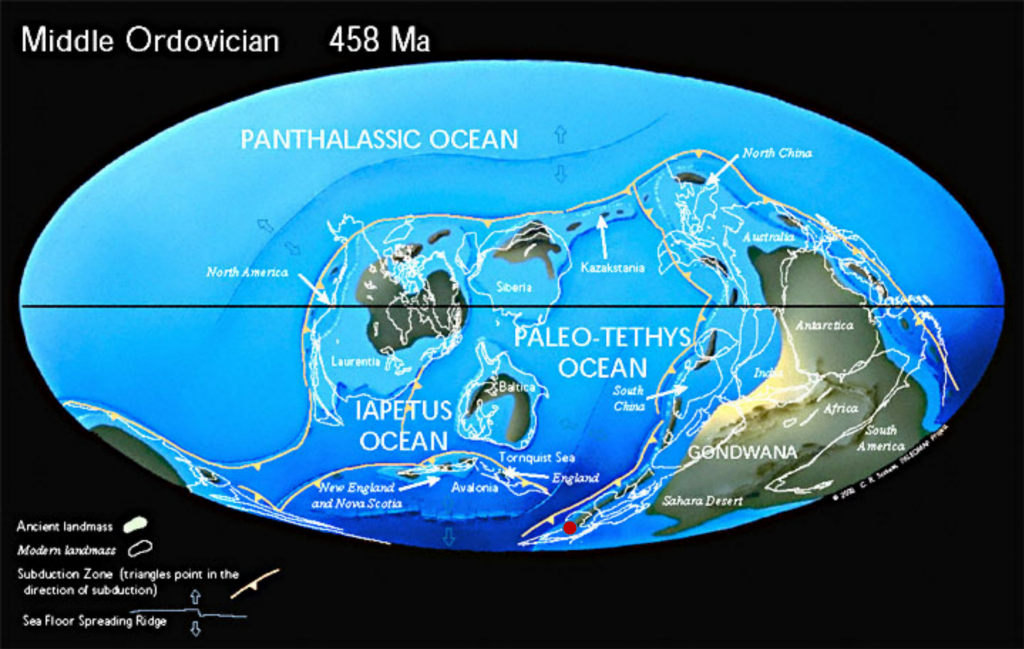
Middle Ordovicianwww.scotese.com
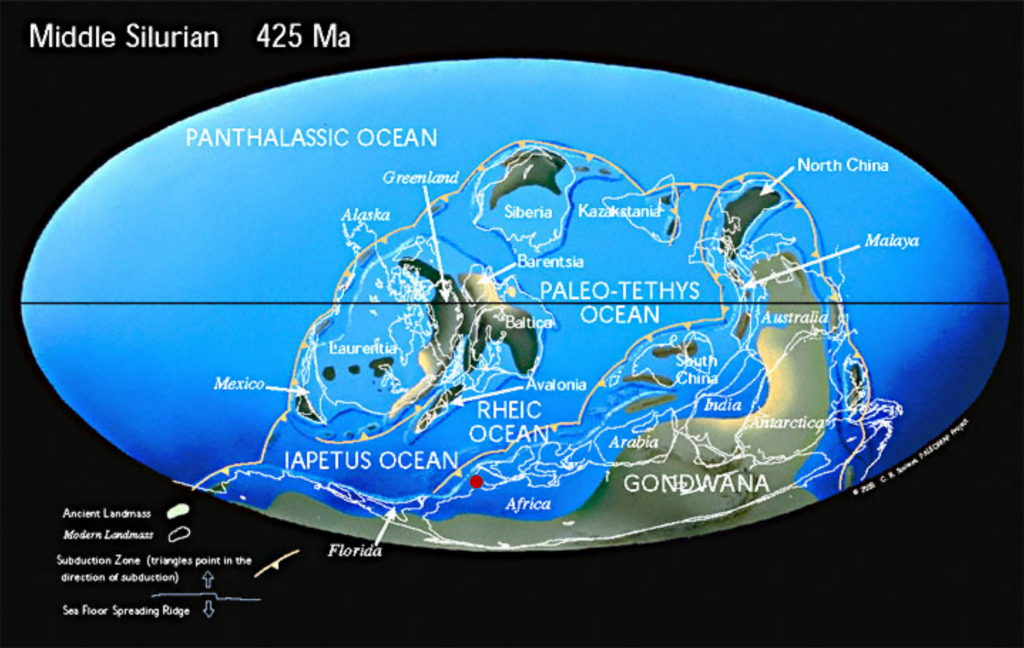
www.scotese.com Silurian
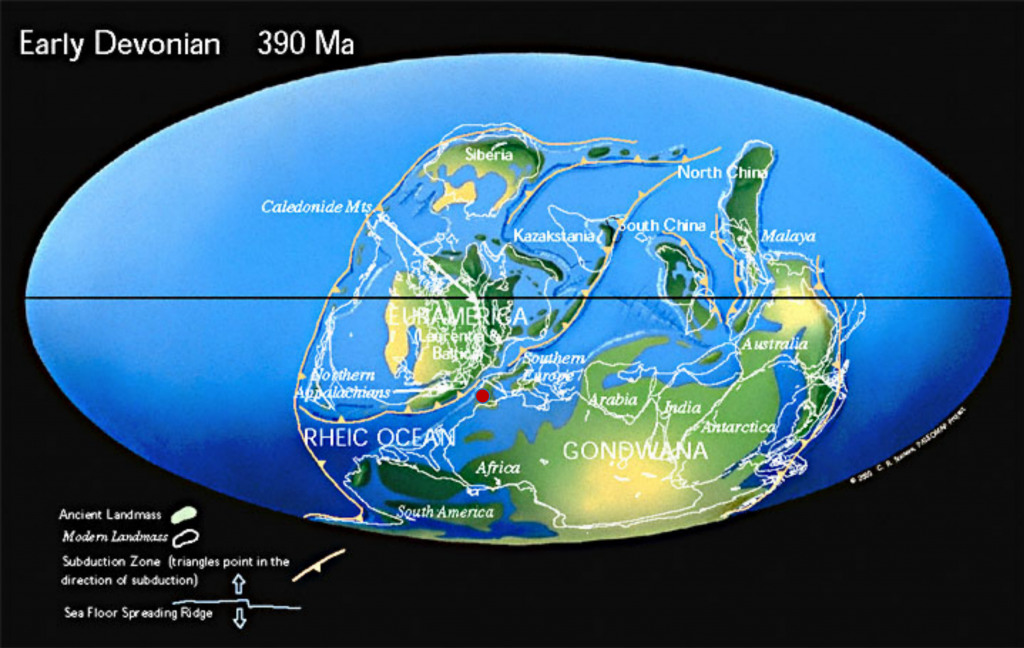
Middle Devonianwww.scotese.com
From a palaeontological perspective, this entire period, spanning more than 100 ma, saw the growth of life in the seas and the colonisation of the Earth. In the Ordovician, the seas were inhabited by invertebrates such as trilobites, graptolites, brachiopods, bryozoans, crinoids and molluscs such as cephalopods (including large nautiloids such as orthoceras). The first jawless fish and the first coral reefs also appeared. Other important groups included marine scorpions and crinoids. In the Devonian, the Age of Fish begins and the Earth begins to be colonised by amphibians and insects.
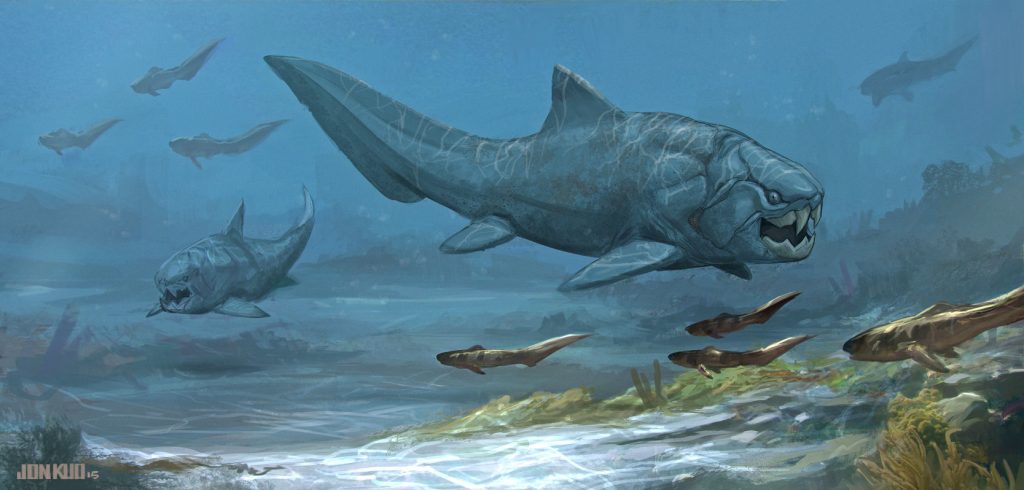
Dunkleosteus «patrolling» the Devonian seas (Jonathan Kuo) www.cronicasdefauna.blogspot.com
4. The disappearance of the Rheic Ocean due to continental collision
Carboniferous – Permian 360 – 250 Ma
The Variscan Orogeny was the dominant and defining tectonic event for the entire Iberian Peninsula and part of Europe. Gondwana and Laurasia gradually moved closer together until they collided (during the Carboniferous and Permian periods, some 360 to 250 million years ago), forming the supercontinent Pangaea. As a result, the oceans that had separated them (Rheic, Palaeo-Tethys) disappeared, and the microplates situated between Laurasia and Gondwana (such as Armorica) were subjected to intense pressure and deformation, resulting in metamorphism, gigantic folds and major faults that made us part of a great mountain range. The fine-grained muds were transformed into phyllites, schists and gneisses; the sands into quartzites and grauwackes; the limestones and dolomites into marbles and calcosilicate rocks; and the volcanic rocks into metavolcanics.
Throughout the process of two large continents moving closer together, the Rheic Ocean gradually disappeared, but traces of its existence still remain. Today, there is a 100-kilometre-long rocky strip known as «Amphibolites from Acebuche» which form part of the oceanic crust of that ocean. Near them, we find the schists and quartzites from Pulo de Lobo, which were oceanic sediments carried into the subduction zone and «pinned» there in the form of an accretionary prism. We are very fortunate to find these rocks today, situated between the ancient microplates of Armorica and Avalonia, as witnesses and representatives of valuable information about the processes involved in the Variscan Orogeny on a global scale.
The pressure and heat caused the cortical rocks to melt, creating large masses of magma which cooled slowly beneath the surface, forming granitic batholiths. Associated with these intrusions, and due to extensive fracturing, significant mineral deposits (Cu, Pb-Zn, Sb) were formed in both Armorica and Avalonia. The Iberian Pyrite Belt (FPI) , to the south of the mountain range, is an example of hydrothermal mineralisation and constitutes the world’s largest area of massive sulphides.
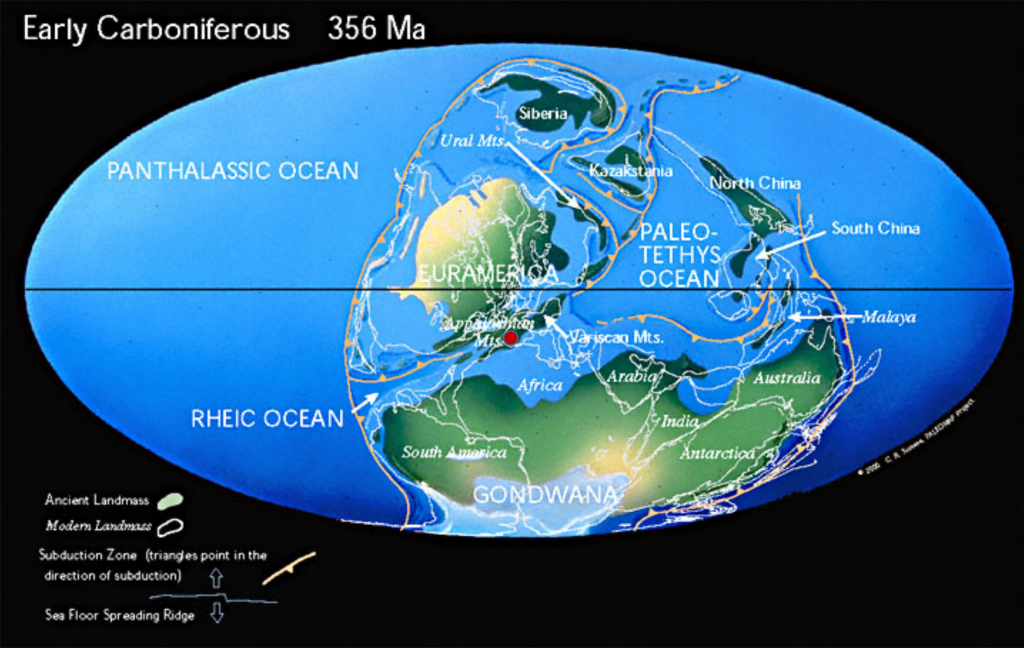
Early Carboniferouswww.scotese.com

Late Carboniferouswww.scotese.com
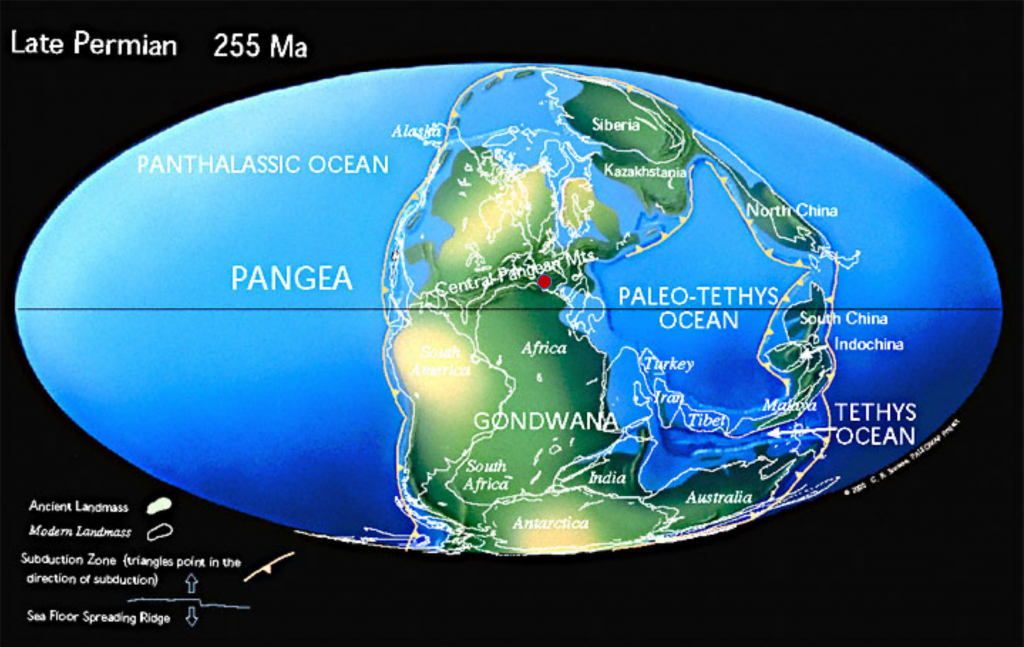
Permian www.scotese.com
The planet was in an era dominated by animals and plants. The vast forests – which are today’s carbon sinks – provided food and shelter for land animals such as large amphibians, the earliest reptiles, arthropods and giant insects. In the oceans, sharks appeared, living alongside trilobites and brachiopods. By the Permian period, the precursors of the future dinosaurs would appear… and much later… we appeared…
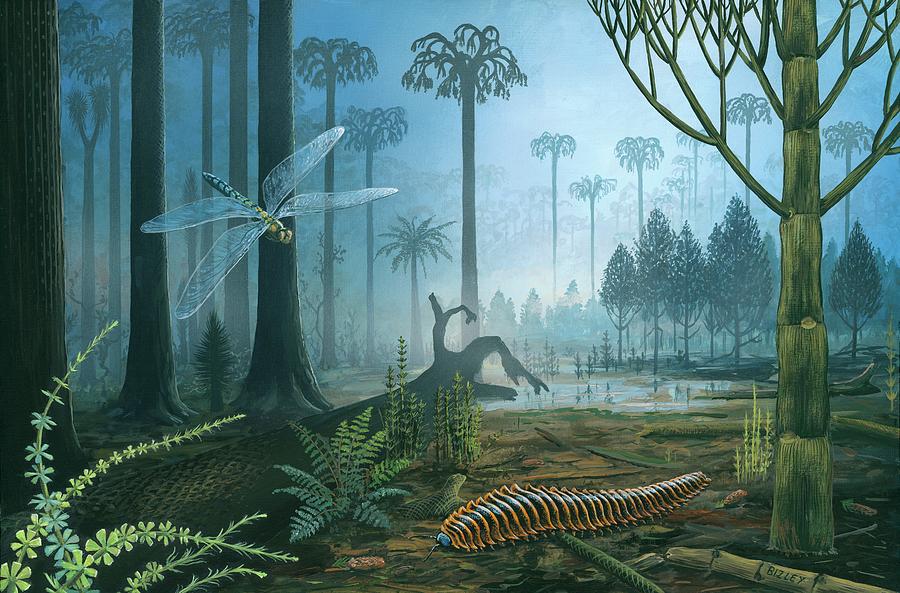
Reconstruction of the Carboniferous world. Drawing: Richard Bizley
www.cronicasdefauna.blogspot.com
5. Erosion and Landscape Shaping
Mesozoic and Cenozoic
Following the formation of the Variscan mountain range, a very long period of erosion began , which continues to this day. Over millions of years, the landscape of one of the highest mountain regions on the planet has been smoothed out, wide valleys have formed, and the peaks have become rounded.
In the Cenozoic, the break-up of the supercontinent Pangaea once again altered the boundaries of the continents. The new forces generated by the Alpine Orogeny – resulting from Africa’s collision with Europe – raised and tilted the Iberian Peninsula, giving rise to new mountain ranges (such as the Pyrenees and the Betic Cordillera) and created new elevations and valleys in our region, resulting in the current river basins: Múrtigas, Odiel, Huelva…
As a result, we now live in a mountain range that has been shaped and eroded, where we can see landscapes with an Appalachian-style relief, characterised by quartzite ridges that have withstood erosion, and fantastic pastures with soils resulting from the weathering of rocks dating from between 520 and 350 Ma. The vegetation, wildlife and traditional uses of the land have been closely linked to the geology. Without our mountain ranges, the clouds would not release the rainfall that is so beneficial to wildlife, flora and river systems. Without our mineral-rich soils, we would not have the marvellous mushrooms and chestnuts that form the basis of the local cuisine, nor would our beloved pigs enjoy such magnificent acorns. Geology is therefore the foundation upon which all the ecological, gastronomic and cultural wealth of the region is built.